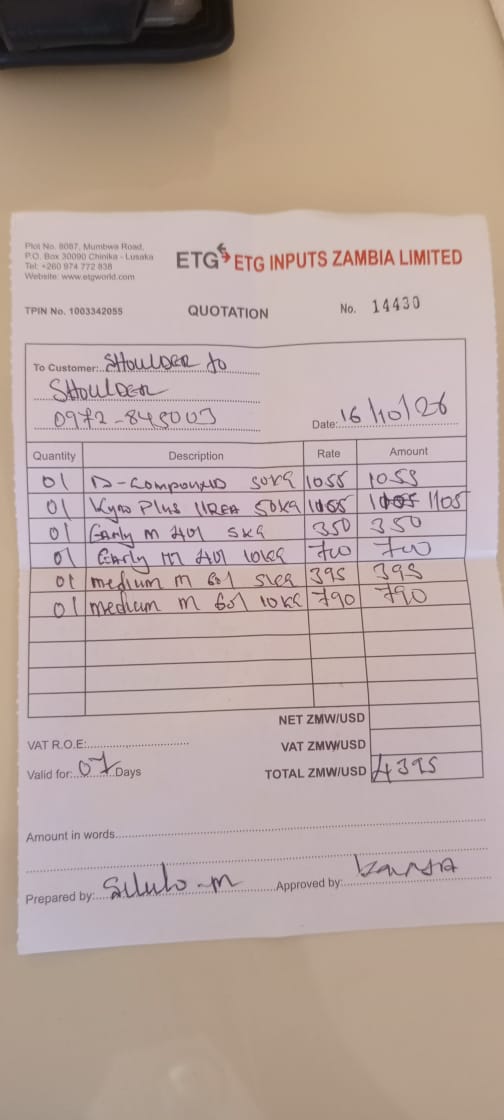
Pretty quiet week in Zambia last week. We are still collecting reports from the October feeding program, so we haven't distributed funds for the November program. This week's cover pic is yet another picture of some of our brothers and sisters at a small rural community receiving some monthly help last month. And we are still investigating and working out details for the inputs program, so we haven't distributed funds for any inputs yet either.
We have collected $55,000 towards the inputs program to this point and are still building that fund here, even has $30,000 is already in country to be put into action soon. But we are still determining exactly how to implement this year's plan in Zambia. As a part of that planning, I got to have a conversation with our favorite corn growing expert, Tracy, this week. I felt like I really wanted his blessing before even considering a switch to local seed this year. He seems to be generally in agreement with what we are thinking, so I asked him in very simple terms to give me an idea the POTENTIAL yields from various types of seeds using the training methods he has been teaching. We were discussing what is believed to be the WORST option for planting: recycled hybrid seed. This is what the most desperate of our brothers and sisters will plant if they can't afford to buy anything better. These are the harvested kernels that came from a hybrid seed. Hybrid seeds are not intended to be recycled. But if you have nothing else, that's what is used. In simplified terms, what I heard from Tracy was that a LOCAL seed (all other factors being equal) can be expected to yield TWICE as much as a recycled hybrid seed. That's a good reason to supply local seed. On the downside, he believes a first-generation hybrid seed (as opposed to a recycled hybrid seed, which would be a second-generation seed) can be expected to yield TWICE as much as the LOCAL seed. Score one for NOT making the switch.
There might be a spreadsheet I need to prepare to make this decision, but again I will use the phrase "one step forward, two steps back." If we provide hybrid seed, they may have their best yield ever, but next year if they don't receive hybrid seed from us again, they will likely go back to using the recycled hybrid and be going backwards. Whereas if we provide local seed, they can actually PLAN to use this year's yield for the following year's seed with NO backward steps at all. And they can do that every year until they have grown to the point they can afford to purchase hybrid seed, should they so choose.
The next issue is finding some quality local seed. There is a concern with Tracy and with the team that there may be unscrupulous seed dealers that will package recycled hybrid seed and sell it as local seed. That means there is more investigation to do. Both Josh in Solwezi and Lamec in the Eastern Region - the two guys on our team that have the most ag training and experience - are now taxed with FINDING some good local seed. Both seem to have some leads, so we will see what that investigation yields before we make a final decision. I just learned the first lead Lamec was checking into is out of business. On to the next...
Let me end with a quick shout out to the Wegrzyn family. I had the privilege to officiate a funeral this week for the father of one of Ronda's best friends. I took the opportunity to share, once more, from the back half of I Corinthians chapter 13, beginning with the incredibly deep and encouraging phrase: "Love never dies." While we don't have much insight into what awaits us after this life is lived, it gives me great comfort to believe love never dies. Love may be one of very few things that never dies. If that is the case, it would seem like something we should dive deeper into in this life. The Wegrzyn family, most of whom I had never met, were terrific examples of this for the three short days I got to spend getting to know them.
Love is a beautiful thing in any setting. And love is THE one and only theme of Shoulder2 Shoulder.